WFHB Bloomington Community Radio

Podcast: Play in new window | Download (22.0MB)
ABE SHAPIRO: Tonight on Disabulletin, Playing For Access: The Transformation Of playgrounds in Monroe County and Bloomington, Indiana.
SHAPIRO:Good evening, I’m Abe Shapiro and this is Disabulletin, where we cover the top stories impacting the disability community across the country and around the world.
SHAPIRO:Good evening. This week we return to Monroe County, Indiana to continue our discussion of park accessibility, but this time from the perspective of traditional parks, and their structures of amusement known as playgrounds. According to this year’s report from the National Parks and Recreation Association, in facilities run by parks and recreation agencies, “93% feature playgrounds.”
SHAPIRO: While these structures of amusement provide disabled and non-disabled individuals with opportunities to challenge and improve their physical abilities and mental stamina amongst other skills, designing them is difficult.
SHAPIRO:Tim Street, Director of the Bloomington Department of Parks and Recreation, explains how the department uses the concept of Universal Design, or designing playgrounds for all kinds of abilities during renovations or initial construction, the challenges that come with this, and how the department works on accommodating disability in general.
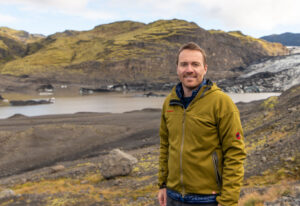
TIM STREET:Playgrounds are a really interesting challenge in terms of identifying the right scope that we should go for. Because inherently playgrounds are designed and [are] supposed to provide some level of challenge. There’s different schools of thought with how playgrounds can be married with the principles of universal design. Certainly approachability and accessibility to the elements is a really key component of any playground we’re putting in. Accessibility [and] universal design are things that we keep in mind when we’re performing any kind of park renovation, rather than just meeting sort of the minimal accessibility standards.
STREET:We certainly have an annual report we do through Michael Shermis and the Community Council On Accessibility, that’s sort of a progress report for the city and marker in terms of areas where we’re improving, or seeking to make improvements. Sometimes we have a really limited footprint, which is a challenge, because in order to have ramps that meet the right grades to be accessible and everything like that, we’ve got to have some horizontal distance that we’re able to put in.
SHAPIRO:A few definitions: Horizontal distance refers to the space between each type of playground equipment so that each person can move from one piece of equipment to the next without hindrance. The footprint refers to the total amount of land reserved for the playground. Accessibility Guidelines for playgrounds were added in 2010 to the Americans with Disabilities Act or ADA, the main civil rights law covering those with disabilities. Located in chapter 10 of the guidelines and summarized by the Northern Iowa University-based National program for playground safety: “Playgrounds, referred to in the guidelines as play areas must: “Have an effective path of travel so that participants with disabilities can reach the area, transfer systems including handrails so said participants can engage with playground equipment near the ground, such as swings or ramps, or equipment above the ground, such as slides with or without their mobility devices, and surfacing which ensures mobility devices can navigate throughout the length of a play area.”
SHAPIRO:[The] Bloomington Parks Department’s Inclusive Recreation Coordinator, Amy Shrake, provides an overview of who writes the guidelines, and expands upon the difficulties encountered by the city’s Parks Department in attempting to meet them, as previously outlined by Parks Director Tim Street.
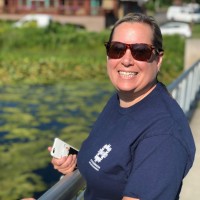
AMY SHRAKE:The Access Board is actually the government agency that writes guidelines, and they have actually written recreation specific guidelines that include playgrounds in it. So we use those guidelines. Federally, there’s the Access Board. And then if someone files a complaint, there’s no ADA police per se, but you can file a complaint with the Department of Justice who would investigate that. And we try to go above when we can sometimes space is limited, we don’t often have the space to put a ramp onto a playground. So, a lot of it is percentage. So it really depends on how many elements you have. If you have a percentage of high elements, you have to have a percentage of low elements that are accessible to people in wheelchairs if they can’t get up to those high things.
SHAPIRO:Even before reaching the playground, one has to navigate the surfacing, or what covers the floor of a playground. Several types of surfacing can be used including Engineered Wood Fiber, Poured in Rubber, or Synthetic turf. But choosing said surfacing is subjective, as it depends on the needs of the community. Amy Shrake describes the difficulties of deciding which surface will be used in renovating playgrounds in Bloomington, which includes balancing accessibility with safety
SHRAKE:Surfacing is a big part of accessibility. And that’s a difficult balance in playgrounds because you want something soft for if a child falls, which is contradictory to a firm and stable surface, which is what’s really required for accessibility. So we’ve been trying to go with the Poured In Place. And it’s very expensive, but that’s our preference that balances that accessibility versus the safety of the fall zones.
SHAPIRO:Fall zones are areas of a playground where a user is most likely to fall and injure themselves. Although engineered wood fiber, which utilizes chips of wood spread across the floor or foundation of a playground, costs less than other surfaces, it requires frequent upkeep via sweeping to comply with ADA guidelines, as it may otherwise hinder the movement of participants with mobility devices if left unswept. Poured in place rubber surfacing, which involves mixing rubber with a binder, spreading the mix onto a playground’s foundation, and then leaving it to dry is also a tried and true method. However, the binders used to keep said rubber in place can deteriorate due to weather conditions and time in general, thereby leading the surface to harden. This can then lead to increased injuries from playground falls, as the surface is unable to absorb a person hitting it while also making free rein of mobility devices difficult as the material is more susceptible to cracking.
SHAPIRO:Dean Schlaudroff, Indiana representative of Snyder Recreation, one of several contractors Bloomington partners with, outlined the positives of poured-in rubber surfaces on playgrounds.
DEAN SCHLAUDROFF:It is by far I think, the most popular surface for inclusive and accessible playgrounds. And that’s for a few reasons. I believe it’s because it’s the smoothest and safest. There are rubber tiles, which work until they start popping up and the underneath moves a little bit. And next thing you know, now you have bumps and ridges that are harder to get through. One challenge with playgrounds is you have to have a full height requirement. So, gravel or concrete or asphalt, obviously you can’t use any of those things because they’re too hard for kids falling on so you are limited on what you can use. So the poured in place rubber has really become, it’s been around for 15-20 years or longer. But it’s made a lot of strides in durability ov er the years and its come to the point that I’d say 95% of playgrounds that are designed as inclusive and accessible end up with poured-place rubber as just being the best surface and longest lifespan and best durability out there.
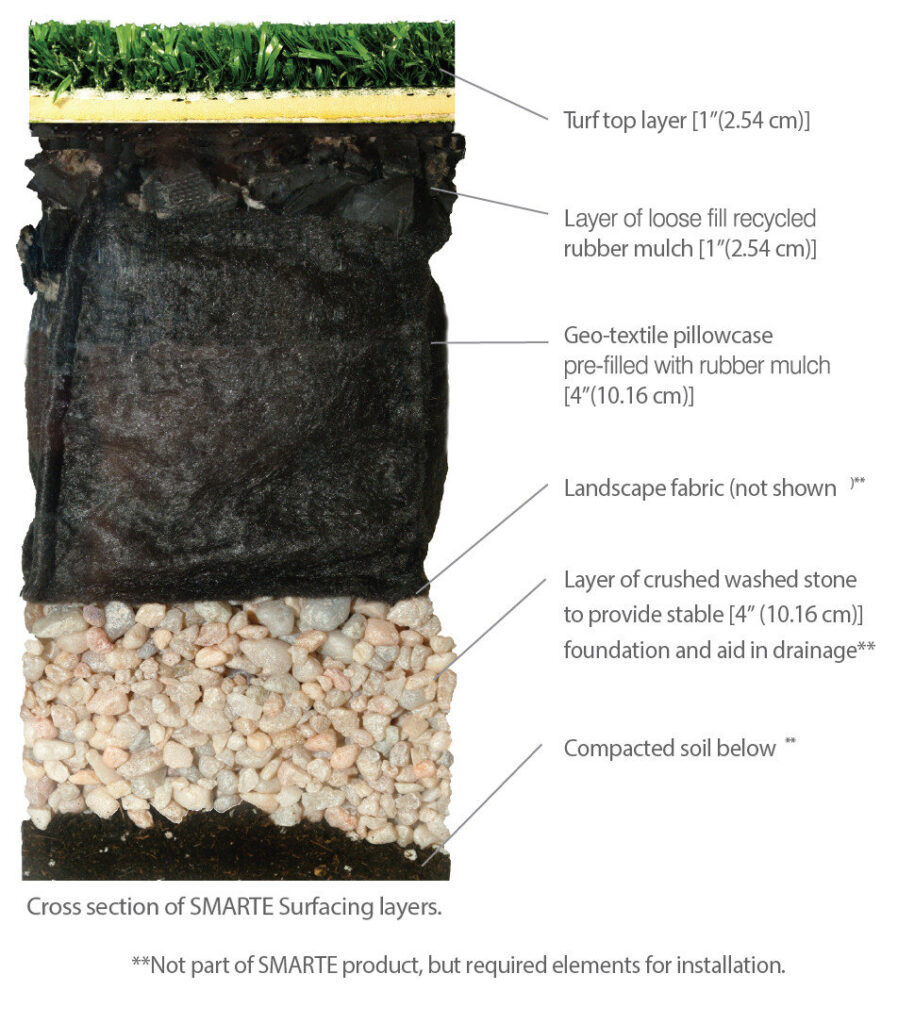
SHAPIRO:The Monroe County Parks and Recreation Department utilizes what is known as the SMARTE method spelled S-M-A-R-T-E in the renovation of four of its seven playgrounds. The other three are slated for renovation at a later time. In interviews with Disabulletin, Elaine Sherman, the president of Parity Incorporated, which invented the SMARTE method, described the benefits of the system by saying: “The process involves inserting cushion like bags filled with 40 pounds of rubber into a playground’s floor. By placing an additional layer of rubber to hold the bags in place followed by a layer of turf carpeting, the odds of surface deterioration and injuries from playground falls are decreased, resulting in a more cost-effective and easier to maintain surface.”
SHAPIRO:Although voluntary, the American Society of Testing Materials has published standards for playground safety ranging from proper playground equipment construction to accessible surfacing.
SHAPIRO:Eventually the time comes when it is time for a playground to undergo renovations. Street and Shrake talk about how playground shelf lives are tracked in the city of Bloomington.
SHRAKE:Our playgrounds are replaced on a schedule, So they’re aging, or sometimes it’s a funding situation so it’s often for various reasons. But typically there’s a Capital Improvement Schedule. And the playgrounds get replaced once their time is up.
STREET:We keep a an inventory of all of our playgrounds. I think we’re at 28 playgrounds right now, around the city. And generally speaking, a playground comes with a lifespan of maybe 15 years on average before you need to be thinking about heavy equipment replacement. Things have worn out, things like that.
SHRAKE:As things come up or money becomes available or if something goes into extreme disrepair, then it may get moved up on the list.
SHAPIRO: In May, following two months of renovation, the oldest playground in the city of Bloomington, located at Bryan Park and built in 1999, will be unveiled with new features matching the aforementioned accessibility requirements outlined in the Americans with Disabilities Act. Parks Department Director Street described the issues of the structure.
STREET:Bryan Park was actually our oldest playground tied for our oldest playground still in the system. Now at Bryan Park, its one of our few playgrounds that’s actually separated where we have a two to five playground two to five year old playground, and a five to 12 year old playground. The majority of the playgrounds in our system are combined, they’re two to 12 year old playgrounds, they’ll either have equipment that’s universal for all ages, or they’ll have sort of an area that’s for the five to 12 range, and an area for the two to five range. And that is basically how playground equipment is manufactured, and how the national standards for safety arrange themselves is around those two age ranges. So the Bryan Park five to 12 year old playground was one of our oldest, there were a number of issues with the playground. The rubber tile surfacing was was getting to be very poor. Safety wise, for impact, it was probably still fine. But accessibility wise, the tile system was not working well. There were big gaps. There were lots of heaves, trip hazards, things like that. And then a lot of the equipment at Bryan Park had worn out. For example, I know it had a zipline that you can grab onto and slide across. And the the part that you grab onto to slide across was gone. And not only was it gone, but it wasn’t manufactured anymore, so it couldn’t be repaired. So looking at inventory and condition assessments through safety inspections, things like that is how we identify where we need to invest. And Bryan Park, for both of those reasons was was kind of at the top of the list.
STREET:And our process has basically been to one, issue a community survey, what are people really looking for in this playground? What is the neighborhood looking for, not just the neighborhood, but also beyond the neighborhood? And then two, create those criteria in the request for proposals that goes out to playground manufacturers, receive those back, and then basically look at and score those proposals. Pretty much anytime we do a playground with a few exceptions what we’re doing is we’re issuing a request for proposals out to a bunch of different manufacturers to help build a playground design that meets the criteria that we’re looking for. One of those criteria that we always include is elements of the playground that are accessible or like I said even better universal.
SHAPIRO:According to a February 19 statement issued by the Bloomington Parks and Recreation Department concerning Bryan Park, the survey generated, “over 400 responses from Bloomington constituents.” Parks Department Director Street summarizes what stuck out about the feedback from constituents.
STREET:You know, one of the things we heard in the survey was that the community was really looking for some challenge elements, because this is one of our few separated five to 12 playgrounds. And so not being with two to five year olds, some of what we heard from the survey was that people wanted to see some unique challenge elements.
SHAPIRO:After looking through the results of the survey, proposals were drawn up and sent to various construction companies, who then created a rough design of the playground in question. Dean Schlaudroff, Indiana representative of Snyder Recreation, which was chosen to renovate Bryan Park, offered his thoughts.
SCHLAUDROFF:The Parks Department reached out to us and I think various other companies and [were] looking to put designs together, They shared a lot of ideas and just overall themes of what they were looking for in the playground renovation. I know the playground has been around a while. Mostly it was [that] the playground’s getting to its lifespan of age. And we wanted to redo it and we wanted to make… like you said it was already accessible. But we wanted to make it even better and more accessible, more inclusive and more features for kids. I think we went through at least seven or eight different designs and the renovations and revisions with the Parks Department. As we kind of worked through: “here’s here’s some designs”, they [would have] feedback with what they like on these and we bring things together and take things off and eventually got to the design that they were happy with on all levels. The challenge with this one was they really wanted a park in a small space, a design that would bring in the older kids because this area is designed for ages five to 12. There’s an area in the park that is for ages two to five. So being five to 12 age, they wanted it to be more exciting [and] bigger to draw in the big kids the older kids that may think they’re too cool for a playground would be like, “okay, I want to go play on that. Because it looks amazing.” So they really wanted us to include a lot of height in our structure. We have a tower on this that is the top deck. I believe it’s 16 foot, is what that top slide comes off at, which is the tallest we go. The way those are designed is we can get that high of a height we get everything up high as enclosed so that your fall height is not 16 feet, there’s no chance of a kid falling from that height. It’s lower down where some of the different climbing and stuff is. But the service thing is also rated for whatever fall height you’re at in different areas of the playground. Yes, our designers take into account all the different disabilities. We don’t just think of wheelchairs. But we think of physical, emotional, and social. And there’s even mental and all those types of disabilities, autism, different things with that level, trying to make sure there’s activities for each. Even some of the towers. Some kids will love crawling up those, some will not, of all abilities. And that’s what we try to provide, that freedom for the kid to have choices and do whatever they feel comfortable with. Bloomington really wanted challenge, they wanted challenge and [something] big and exciting for those older kids. So we tried to put in a big tower. We’ll have what we like to call the ninja wall, we call it our Victory Climber. That’s going to be a really neat piece because it is that big tall wall that people see on TV and it gives the kids and you’ll see adults trying that to see if they get to the top. But it’ll be a fun piece that will draw people in.
SHAPIRO: A committee in the Parks Department then met to discuss what equipment would be included in the new playground based on the submitted designs. Coordinator Amy Shrake who is on the committee says
SHRAKE:Our vendors will design a playground and then we all get together, the committee, and look at the different options and choose what we think would be best for the park that we’re looking at. It’s a little bit interesting because you can’t say, “I want this piece from this company and this piece [from another], you have to go with a whole plan. So with Snyder, there was a couple of things that we just really liked about their entire plan. When we do our Request for Proposals, we require that accessibility be a consideration. And so then we can pull up those guidelines from the Access Board and look at what they have given us and make sure that we have enough elements that are accessible and inclusive and try to best use our space so that we have fun things but also we’re not leaving anyone out. Sometimes there’s specific elements and mostly we were looking for f. We didn’t want to do the same thing that they have at Cascades,we really want it to be a different sort of playground. So we were looking at things that were different experiences
(STATION ID) SHAPIRO:You’re listening to Disabulletin here on WFHB 91.3 Bloomington, Indiana.
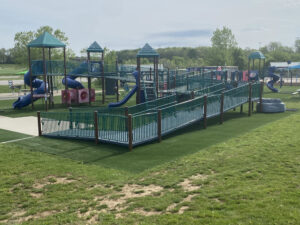
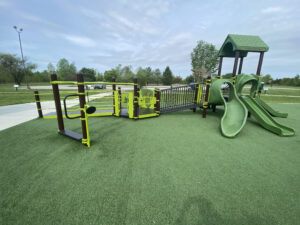
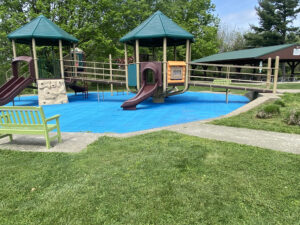
SHAPIRO (Voiceover):Lower Cascades Park on the outskirts of Bloomington features two accessible playgrounds, one for two to five year olds, and one for five to 12 year olds. The five to 12 year old playground features two ramps allowing wheelchair users or other individuals with mobility disabilities to access the playground more easily. What’s more, there are several transfer platforms all across the playground, allowing for easy transfer from wheelchairs.
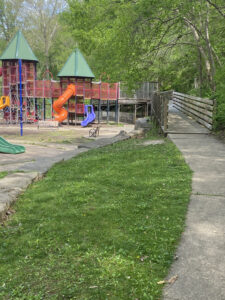
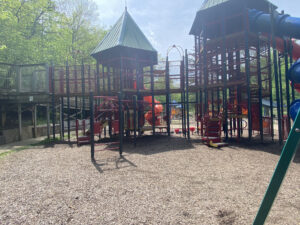
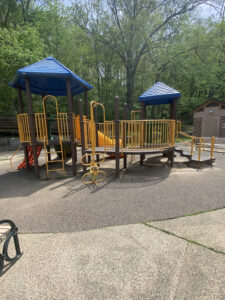
SHAPIRO:Parks director Tim Street and contractor Schlaudroff outlined some of the newest components of Bryan Park’s upcoming playground.
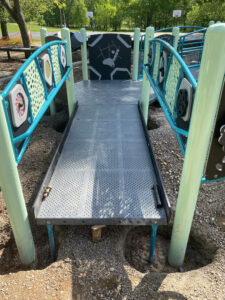
STREET: What I’m pleased with at Bryan Park is that one, we’re going to have a complete section that is passable through the Bryan Park playground, that is wheelchair accessible. It actually incorporates, there’s a ramp spot coming off of an existing wall at the Bryan Park playground that was used with the old playground that will be reused. But now it won’t be a go in and turn around and come back out type thing, you could pass all the way through on this ramp. Forgive me, I’m forgetting the specific name of the elements, all the playground companies have names for all the elements that they put in. And if you talk to Snyder, I’m sure they’ll know. But this this little bridge that has some horizontal shaking to it some lateral movement, which is fun. And then a ramp out on the other side. Of course, we’re trying to not just think of physical disabilities, but also considering sensory play and things like that. Tactile things that can be played with and then also at Bryan, we have something that’s going in there that’s kind of like the Ninja Warrior Warped Wall. Now the accessibility of that is a great question. You know, what does that look like accessibilitywise? Because it is a physical challenge. People can basically do it as is, there’s gonna be a shorter one and a taller one. And then one of them has actually some handholds in it to to basically provide another element of challenge, where you can bypass the handholds and you can try to make it straight to the top. Or you can use the handholds to try to get up. And then the last great thing I’m excited for with Bryan Park playground that’s sort of specifically accessibility oriented is our new spinner, we’re gonna have a new spinner, that carousel spinner, that’s right at ground level. You can easily get on and off of it and spin around and have a good time on that. And then of course, with our swings, there’s a few different types of accessible swings, or universal swings. Different manufacturers have different ways of creating those. And so we have an assortment depending on the manufacturer of different types of what is manifesting as the universal swing.
SCHLAUDROFF:The previous one [Previous Bryan Park Playground], there’s a ramp going into the structure. This design that we put together, we kept that ramp coming off there. We also added another ramp elsewhere in the playground, so the kids can go through the playground, as opposed to just on for a little area and then have to get back off. There’s a lot of features in that area that the kids can get to from the ramps from either end, a lot more play panels, a lot more ground level base, a lot more sensory type activities, and play panels, even little quiet spots for kids that are a little overwhelmed by the excitement of a playground that they can tuck into and be safe. One of our products [is] called the Innova Bridge, which is actually within the ramp structure the kids can get onto. It moves back and forth, to give them that sense of movement, without having to get on a swing or something else. We did add our inclusive orbit, which is basically a merry go round, but it’s ground level. So wheelchairs and and all kids can just walk right onto it, wheel onto it and still get that spinning motion along with the other kids. I would say that there’s enough, that there’s so much on the playground, that realistically, like the victory wall, somebody in a wheelchair is not going to use, that’s not a piece that they’re able to use. But there’s so much other stuff around and nearby that they will be able to play with the kids throughout the area together. So I believe that’s what we tried to do is bring it together so that everybody is playing together. There are some pieces that not every kid’s going to use. But that’s going to be on every playground because you’re always [going to] have kids that are more adventurous and some that are not. But we want to make sure we give each kid some space, in some area to play with their friends. We probably do 100+ playgrounds a year and more and more are becoming accessible. And accessible can mean various things depending on the different playgrounds. There’s elements in every playground, but some of them have a much higher focus. And I would say more and more communities are going to that, which is wonderful to see, just to be able to bring all the kids together. And one thing we like to talk about when we’re talking about accessible playgrounds is not only accessible but inclusive. We really like to push the idea that not only do you make the whole playground accessible for kids of all abilities, but you make it in such a way, you design it in such a way that the kids are all playing together, not just limiting disability in one area and other kids in another area. You want them all playing in the same area so that everyone feels a part of the same community.
SHAPIRO:Finally, Slaudroff and Parks Director Street outlined the resources and strategies utilized by both, to ensure that playgrounds such as Bryan Park remain legally accessible both during and after construction, whilst preventing said playgrounds from falling into disrepair.
SCHLAUDROFF:Burke, who’s a manufacturer of the company, their designers in their office put together plans and designs that meet all of those things. And they give us extremely well detailed installation instructions and drawings and everything else that we then share with our installers on site. And they follow those to a tee for each of those parts and pieces to make sure as they’re going that it does meet the standards. They’re checking, my installers are checking as they’re going, i’m checking as they’re going to just make sure as it moves along, we’re doing everything on the right level and then the last step will be the surfacing and working with our surface provider to put the poured in place rubber surface down so that it meets all the requirements
STREET:We have certified playground safety inspectors on staff. There is a very standardized program out there to inspect playgrounds for safety risks, hazards, things that might become hazards and in the course of basically inspecting for safety, you’re really also inspecting for quality and longevity at the same time. Because these inspections are pretty thorough, you’re looking at, “Are bolts tightened? Is anything rusting? Is anything becoming unsafe? Inspecting it at least twice a year is our standard for most playgrounds, more on some of our more heavily used playgrounds allows us to catch issues and to take care of them before they become something that might threaten its lifecycle.
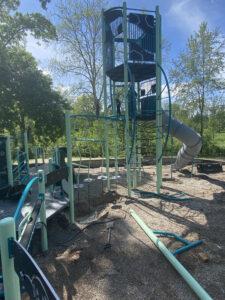
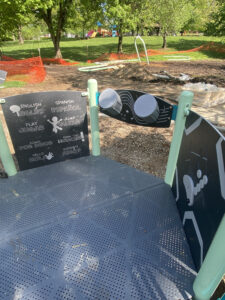
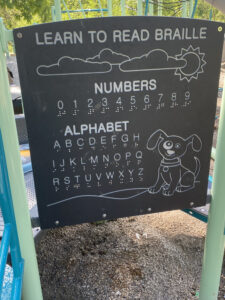
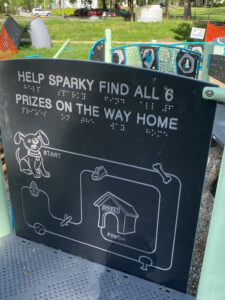
SHAPIRO:Standing at the edge of the [Bryan Park] playground, there’s certainly much work to be done. But the playground is starting to form. Although the rubber foundation has yet to be installed, portions of the climbing platforms are in place. Beginning from the left side of the playground and spilling into the middle of the structure, one can climb up on a platform and be greeted from left to right by multicolored spinning devices, and a feeling-wall portion made of green turf. Approaching the middle of the platform, a sign reading “Hello, thanks, please, goodbye, play and jump” in English and Spanish can be found, followed by a drumming station. On two of the playground’s walls, a participant can practice their tactile skills or learning by touch. The walls feature Braille numbers by referencing numbers zero to nine with their Braille equivalents located underneath, followed by a similar outline of the alphabet. A second wall encouraging visitors to help a dog named Sparky navigate a maze features Braille lettering as well. A climbing letter made of ropes on the far right side of the structure caters to the adventurous visitor and is attached to two levels of height followed by a slide. Progress has been made and the Park is scheduled to be open later in May.
SHAPIRO:Disabulletin is created and produced by me, Abe Shapiro. Our theme music is Baseball is more than a game by the George Romanis sound. Abe Shapiro WFHB news, live and learn.