WFHB Bloomington Community Radio

Podcast: Play in new window | Download (Duration: 7:52 — 10.9MB)
Subscribe: RSS
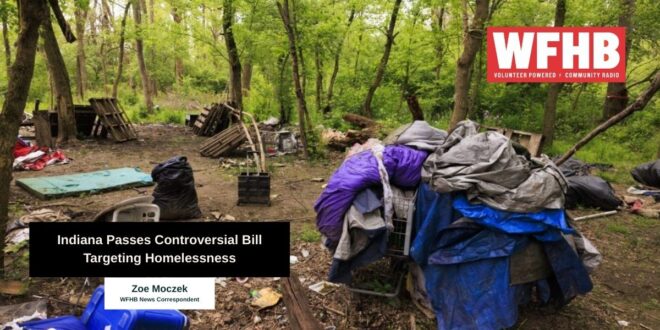
Under a new Indiana bill, unhoused people may soon be forced to leave their encampments or face criminal charges.
Indiana Governor Mike Braun signed Senate Bill 285 into law on March 5th. This bill prohibits a person from sleeping, camping, or taking long-term shelter on public land. Those who do so could also be charged with a Class C misdemeanor if they are still in the area 48 hours after receiving a warning.
Senate Bill 285, authored by State Senator Cyndi Carrasco, was introduced on January 12th. On February 26th, the Indiana Senate agreed to House amendments, passing this bill with a 28-22 vote. Carrasco and other proponents of the bill say it aims to address homelessness in an effective way, while opponents argue that it essentially criminalizes being unhoused.
State Representative Matt Pierce opposed the bill. Pierce said a more effective way to address street homelessness would be to expand treatment capacity for substance use disorders and mental health challenges, which are underlying causes of homelessness.
“Instead of passing this bill and creating another opportunity to warehouse people in jails who should be in facilities where they can get treatment, we should be putting our resources and our efforts into building up this mental health and drug treatment capacity so we can actually serve the underlying causes of the problems that unhoused people face,” said Pierce.
Pierce added that the bill is likely to place additional strain on already overcrowded jail systems.
“One of the things they say is, ‘Well, the officer doesn’t necessarily have to arrest the person, they can just issue them a summons, since it’s a misdemeanor.’ But what is likely to happen is if you have an unhoused person who is battling substance use disorder or a mental health challenge, chances are they’re gonna miss their summons to appear,” said Pierce. “So then a bench warrant’s gonna go out for failing to appear at their hearing, and then that’s gonna get them arrested and incarcerated.”
Senate Bill 285 also states that when a police officer encounters someone using public land in violation of the bill, they are required to determine if that person qualifies for an emergency detention order due to mental illness. If so, that person will be placed on an involuntary hold at a medical facility, typically for up to 72 hours.
“The Republicans in the House were trying to address all the criticisms that we were leveling at the bill, and so they created all these different off-ramps which are not likely to work, but they were trying to combat the allegation that they were criminalizing homelessness,” said Pierce. “And so they put things in the bill where if the police officer wants to, instead of just arresting the person, the police officer could seek to have an emergency detention order, which essentially puts someone in a civil commitment. That then means that they’re going to be in a hospital using up space there that may not very well exist because we don’t have these regional treatment facilities to offer residential treatment programs.”
WFHB also spoke with Andrew Bradley, the Senior Director of Policy and Strategy for Prosperity Indiana, an organization that aims to strengthen Hoosier communities through social and economic opportunity. Bradley said he’s concerned that requiring law enforcement to decide if a person sleeping in public qualifies for emergency detention will create more complications.
“That’s gonna require some really specific new training and public information – not just for law enforcement so they know how to correctly diagnose somebody in a park or another public space, but also for homeless service providers so that they can be able to provide information to the people that they work with, to the court system so that they know how to deal with another provision that was added saying that if there’s no housing or services available, that can be used as a defense once you get to court,” said Bradley. “So suddenly we’ve added these new what were thought of as mitigating factors but really are complicating and confusing factors to this already problematic law.”
Bradley added that Senate Bill 285 will have economic drawbacks. Prosperity Indiana published a fact sheet outlining the potential monetary cost of the bill, estimating an additional one to two million dollars per year due to the costs of holding a greater number of people in local jails. This prediction was based on data from the effects of a similar bill that passed in Kentucky in 2024.
“I think something that was not fully understood by the legislature is that under this law, whenever there are no housing and services available, the direct path into the criminal justice system will require that 14,000 bed nights per year will be used to house homeless Hoosiers rather than true threats to public safety,” said Bradley.
Bradley went on to say the possibility of criminal charges will likely have a negative effect on relationships between unhoused people and law enforcement.
“Unfortunately now that we know that there’s a Class C misdemeanor that could be charged at any of these interactions, that’s gonna mean that homeless people are going to try to avoid any interaction with law enforcement, and that could escalate what could previously have been positive interactions, and now adding a new heightened sense of danger to those,” said Bradley.
Brian Giffen, the Homelessness Response Coordinator for the City of Bloomington, said Senate Bill 285 will require the city to make significant changes to its current approach to addressing street homelessness.
“For us in Bloomington, when we encounter larger scale encampments that are on public property, we try to do our best to work with those folks to make sure they can get access to resources and services. And if we ultimately need to make the determination to close those encampments, we give a 30 day notice,“ said Giffen. “So, shortening that to 48 hours and then requiring that we comply with that policy just is kind of an overstep, and it’s also just a radical change to how we’re trying to handle homelessness issues with compassion and understanding and really trying to help these people rather than penalize them for having to be in these situations.”
Giffen also noted that the most effective approach to helping people experiencing homelessness in Indiana varies from one community to the next.
“They’re forcing a policy on every community. Some other communities, they don’t have policies, this maybe gives them an outline for how they could enforce,” said Giffen. “But it doesn’t fit Bloomington, it doesn’t fit our plan, and it just doesn’t really provide anything other than effectively criminalizing sleeping outside.”
Senate Bill 285 is scheduled to go into effect on July 1st. Representative Pierce encouraged Hoosiers who feel strongly about this issue to make their voices heard.
“I just think it’s important for all of us not only to pull together in helping our nonprofits on a local level who are dealing directly with these issues, but also just make sure our voices are heard to the legislature, and particularly asking candidates for office what they think is the best approach,” said Pierce. “Do they think this idea of criminalizing homelessness is the way to go, or are they willing to support actually providing resources to solve the underlying problems that contribute to what we see happening on our streets?”