WFHB Bloomington Community Radio

Podcast: Play in new window | Download (Duration: 29:58 — 68.6MB)
Subscribe: RSS
In this week’s edition, an interview with Ava Hartman, the Executive Director of Canopy Bloomington, a social impact organization aiming to grow and sustainably manage the urban forest.
Climate change is significantly impacting Canadian wildfires, making them more frequent, intense, and prolonged. This is due to factors like increased temperatures, reduced precipitation, and earlier snowmelt, which dry out vegetation and create conditions more conducive to fire. As a result, Canada has experienced record-breaking wildfire seasons, with more than 200 uncontrolled fires currently. Every year the fire-line advances eastward and could reach Hudson Bay within a few years, Plus that, with higher temperatures, there is less likelihood of winters cold enough to kill the pine beetle.
Approximately eight million tons of cod were caught between 1647 and 1750, a period encompassing 25 to 40 cod generations. The factory trawlers took the same amount in 15 years. The industry collapsed entirely in the early 1990s owing to overfishing and debatably, greed, lack of foresight and poor local administration. The fishery was closed in 1992, but recovery looked doubtful for decades. Finally, the cod are coming back and this year there has been modest production. Needless to say, Newfoundlanders are overjoyed.
The U.S. Supreme Court has ruled in favor of a controversial Utah railway project that critics say erodes the National Environmental Policy Act (NEPA), a bedrock of environmental law for the past half century. The case centered on a proposed 88-mile railway that would connect the oil fields of northeastern Utah to a national rail network that runs along the Colorado River and on to refineries on the Gulf Coast.
The waxy crude oil is currently transported by truck over narrow mountain passes. Project proponents said shipping the fossil fuel by rail—as many as 10 trains daily—would be quicker and revitalize the local economy by quadrupling the Uinta Basin’s oil production. ICN previously reported, Environmental groups and Eagle County, Colorado, opposed the railway project. They cited the potential for derailments and spills into the Colorado River, the drinking water supply for 40 million people.
Opponents were also concerned about increased air pollution in the Uinta Basin, where oil fields emit high levels of methane, a potent planet-warming greenhouse gas, as well as volatile organic compounds, some of which have been linked to increased risks of cancer. Gulf Coast communities would also be harmed by air pollution when the crude oil was refined, opponents argued. The increased oil production and associated emissions would also drive climate change and its disastrous global effects: hurricanes, floods, droughts and extreme heat.
I guess you have heard – Red Dye No. 3 is out! That bright red cherry on top of your ice cream sundae? The pink frosting on your kid’s birthday cake? For decades in the U.S., these have been made with a synthetic dye that is linked to thyroid cancer. But that’s about to change. In the past days of the Biden administration, the federal Food and Drug Administration announced a long-overdue ban on Red Dye No. 3.
The decision marks a major win for science-backed regulation and decades of advocacy. It comes after more than 30 years of pressure to eliminate the dye from food and drugs. Responsibility for enforcing the ban now falls to Trump administration Health and Human Services Secretary Rober F. Kennedy, Jr. The U.S. now joins other nations that have already restricted or banned Red Dye No. 3 in food.
A massive cloud of dust that has traveled thousands of miles from the Sahara Desert is expected to reach Florida as early as the afternoon of June 4 before spreading through the Gulf Coast and Southeast later in the week, forecasters said. Most of the dust, which is thought to be about 2,000 miles wide from west to east and 750 miles long from north to south, will remain high in the atmosphere and have little effect on air quality and health for most people, according to AccuWeather. Floridians could start to see hazy skies or colorful sunrises and sunsets midweek.
“This is the biggest Saharan dust plume that we’ve seen so far this year. It is very common to see large plumes of Saharan dust coming across the Atlantic toward the United States in June and July,” AccuWeather Lead Hurricane Expert Alex DaSilva said. “Many people will notice more colorful Saharan dust, while a natural phenomenon, can exacerbate algal blooms in Florida, impacting manatees and other marine life. The dust’s iron content can fertilize the water, leading to increased algal growth, including red tides, which are harmful to the environment and can cause respiratory issues in humans. This can also negatively impact manatees by reducing their primary food source, seagrass.
The National Oceanic & Atmospheric Administration’s outlook for the 2025 Atlantic hurricane season, which goes from June 1 to November 30, predicts a 30% chance of a near-normal season, a 60% chance of an above-normal season, and a 10% chance of a below-normal season. The agency is forecasting a range of 13 to 19 total named storms (winds of 39 mph or higher).
Here are other implications of this forecast. It implies ocean temperatures will be high. Indeed, some areas of the Gulf of Mexico and the Caribbean are already in the mid-80s. With ocean temperatures this high, it’s a virtual guarantee there will be a bleaching of the few remaining coral reefs this summer.
In 2025, Indiana is forecast to add over 1 gigawatt (GW) of utility-scale solar capacity, contributing to a national total of 32.5 GW. This growth is part of a broader trend of increased solar power adoption in the U.S., with utility-scale solar expected to be a major source of new electricity generation capacity.
In 2025, Indiana’s wind power industry is projected to experience growth, with the National Renewable Energy Laboratory predicting potential wind capacity reaching nearly 40,000 MW by 2030. This growth is supported by a new pipeline of wind projects in development or construction. Indiana is expected to add more than 1 GW of new solar capacity in 2025.
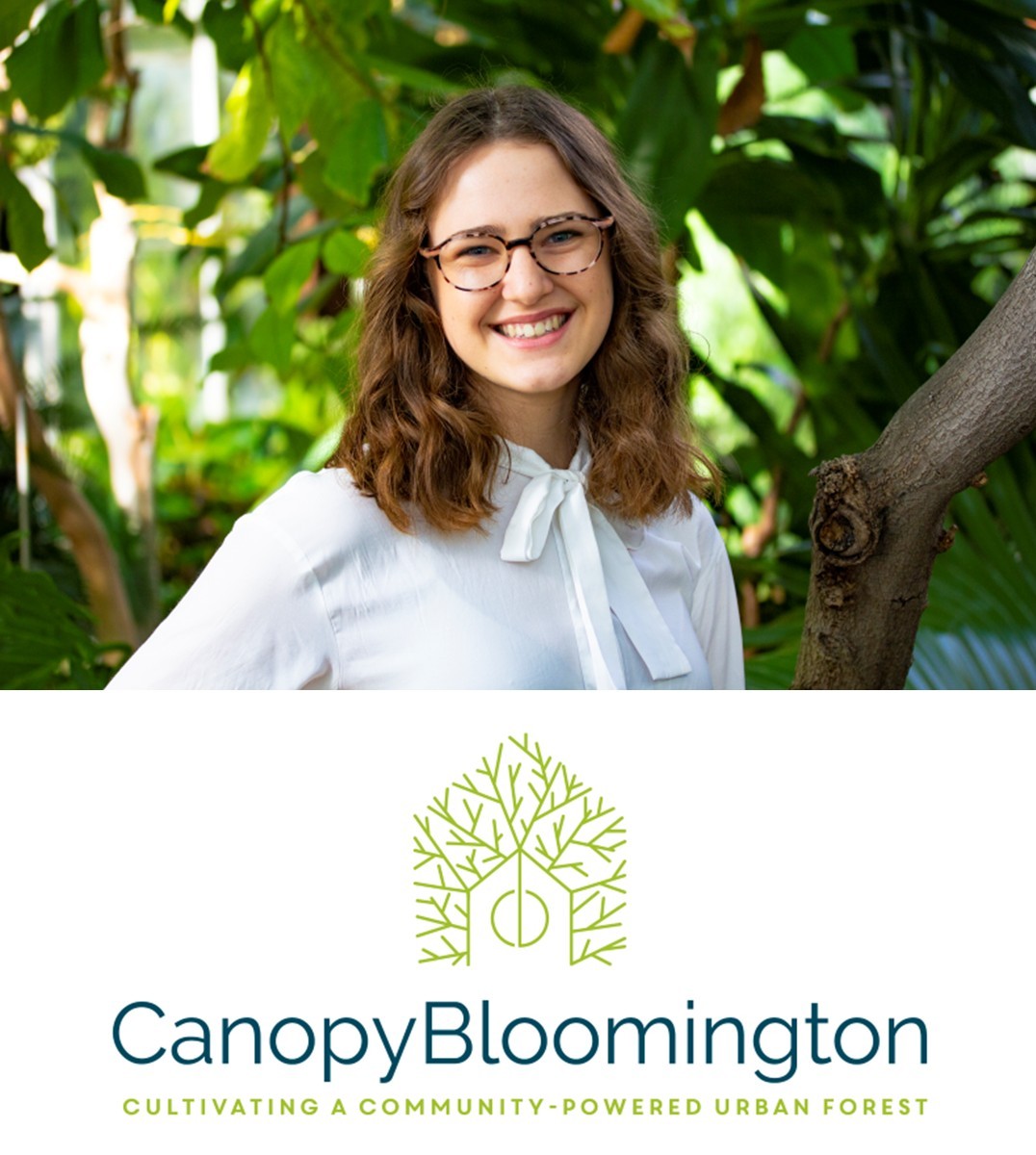
In this week’s edition, an interview with Ava Hartman, the Executive Director of Canopy Bloomington, a social impact organization aiming to grow and sustainably manage the urban forest.

- Free Fishing is available at all state park public waters on Saturday, June 7th and Sunday, June 8th, all day. Take this opportunity to learn how to fish.
- Learn about Extinct and Endangered Animals at Brown County State Park on Sunday, June 8th from 11 to 11:45 am. Meet in the Nature Center to listen to a presentation about extinct, extirpated and endangered animals.
- Explore Monroe Lake during a Monroe Paddling Trip at the Crooked Creek State Recreation Area on Sunday, June 8th, beginning at 7 pm. Explore the quieter side of Monroe Lake as you journey through backwaters, wetlands and more. Register with [email protected].
- Take a Strawberry Full Moon Hike at McCormick’s Creek State Park on Wednesday, June 11th, from 10 to 11:30 pm. Hike to the highest point in Owen County as you learn fact and fiction about the Strawberry Full Moon.
- Take a 2-hour Pollinator Habitat Workshop at Rogers Family Park on Saturday, June 14th, from 9 to 11 am. Learn how to restore pollinator habitat. Please register at bloomington.IN.gov/parks.
Credits:
On Air…………………………………Julianna Dailey
On Air………………………………Frank Marshalek
Headlines…………………………………Norm Holy
Headlines…………………………….Julianna Dailey
Feature Report……………………….. Ava Hartman
Feature Report………………………Julianna Dailey
Feature Report………………………… Kade Young
Script…………………………………Julianna Dailey
Events Calendar…………………….Julianna Dailey
Engineer…………………………..Branden Blewett
Are you looking for a way to make a difference on environmental issues?
Eco Report is looking for reporters, engineers, and segment producer to report facts on how we’re all affected by global climate disruption and the ongoing assaults on our air, land and water. We also celebrate ecologists, tree huggers, soil builders and other champions who actively protect and restore our natural world, particularly those who are active in south central Indiana. All levels of experience and all ages are welcome, and we provide the training you’ll need. WFHB also offers internships.
To volunteer for Eco Report, call at (812) 323-1200, or e-mail [email protected].