WFHB Bloomington Community Radio


Podcast: Play in new window | Download (Duration: 28:54 — 39.8MB)
Subscribe: RSS
This is Eco Report for Friday, February 20th, 2026.
Coming up later in the program, Gloria Chi, known on WFHB as Glo With Flo, talks about the Indiana Sustainability and Resilience Conference she attended. And here are your weekly environmental reports:
Asian Bush Honeysuckle: Invasive Species in Indiana
By Rich Benak
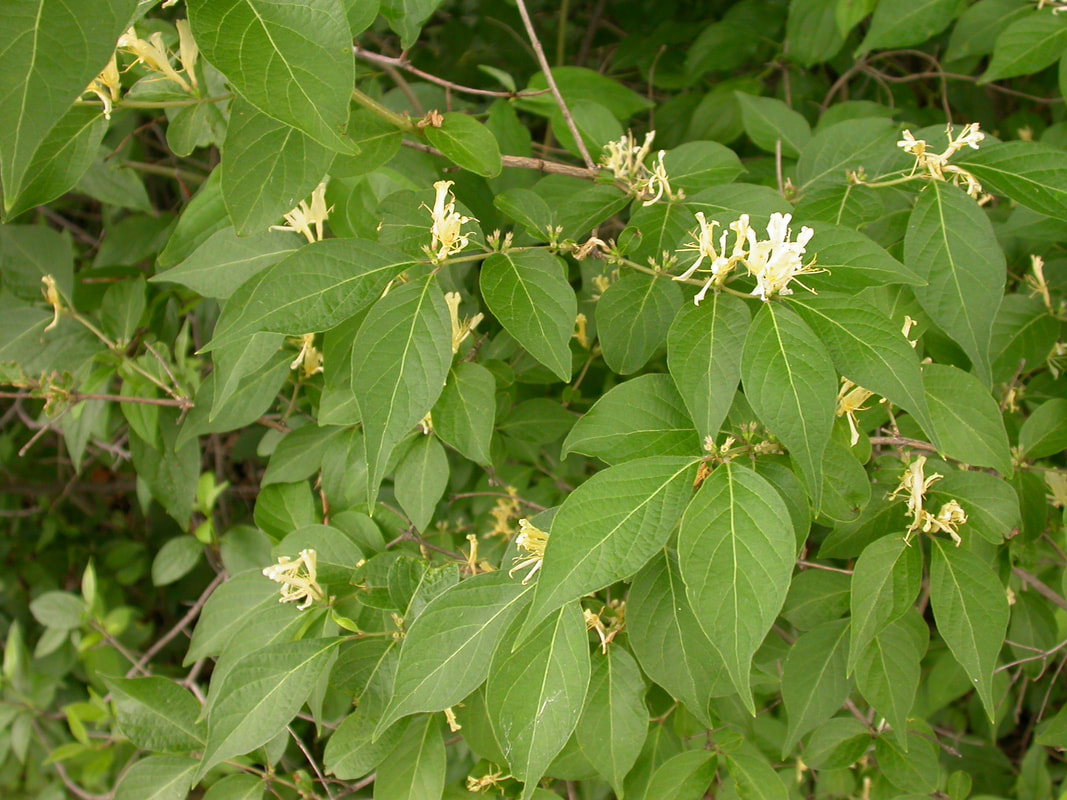
As we continue our lesson on invasive species in Indiana, we will now teach you about the Asian bush honeysuckle. The thing about honeysuckle is you can see it in the winter. The leaves stay green. That makes it easy to see. “Every single county has Asian bush honeysuckle within probably 200 feet of where you are sitting according to Ellen Jacquart, a retired botanist and president of Monroe County – Identify and Reduce Invasive Species (MC-IRIS).
There are three species in the US: Tatarian honeysuckle from Russia, the Morrow’s honeysuckle from Japan and the Amur honeysuckle from China. We have the Amur honeysuckle.
The plant grows quickly and spreads large patches into the understory, crowds out native plants and small trees. You can combat the Amur honeysuckle by completely digging up the plant, roots and all. If you don’t, it comes back.
Another invasive species is the Oriental Bittersweet. It was brought to the US from the lowlands of Eastern Asia. It is a thick, snarling vine that produces bright yellow leaves and orange berries. People like to use them for holiday wreaths.
Birds and other wildlife eat the berries and spread the seeds, so now it is taking over our national and state parks, forest floors and natural areas.
Oriental Bittersweet like sunlight, so it tends to snake up into the trees. The vines can grow up to six inches in diameter and it can cut off a tree trunk’s ability to transport water internally. Once it gets into the treetops, it spreads far and wide and blocks out the sun.
This is another plant that must be completely dug up and destroyed. I have heard that some people simply cut the vine, which, of couse would kill the plant up in the trees, but the roots will continue to grow and the vine will come back.
Climate Report: Winters Are Getting Colder
By Caitlin Looby

A new Climate Central analysis shows that winters across the United States are getting noticeably shorter, with 80% of 245 studied cities losing an average of nine winter days compared to the period from 1970–1997. The Great Lakes region—including Milwaukee—is among the fastest‑changing, experiencing warmer, wetter winters with less snow. Alaska saw the most dramatic shifts, with Juneau’s winter shortening by 62 days and Anchorage’s by 49.
Scientists note that winter research on the Great Lakes is difficult due to hazardous conditions, but multiple studies confirm rapid changes: winters have shrunk by more than two weeks, and Lakes Michigan and Huron no longer reliably form winter layers. Ice cover has steadily declined over the past 50 years, threatening the region’s $7 billion fishing industry, coastal infrastructure, and increasing the risk of harmful algal blooms.
The report emphasizes that climate change—driven largely by fossil fuel emissions—is the primary cause of these shifts. However, recent actions by the Trump administration, including the EPA’s repeal of its finding that greenhouse gases contribute to climate change and the omission of climate change from the latest State of the Great Lakes report, make monitoring these impacts more difficult.
Indianapolis Residents Push Back Against Data Center
By Carrie Albright
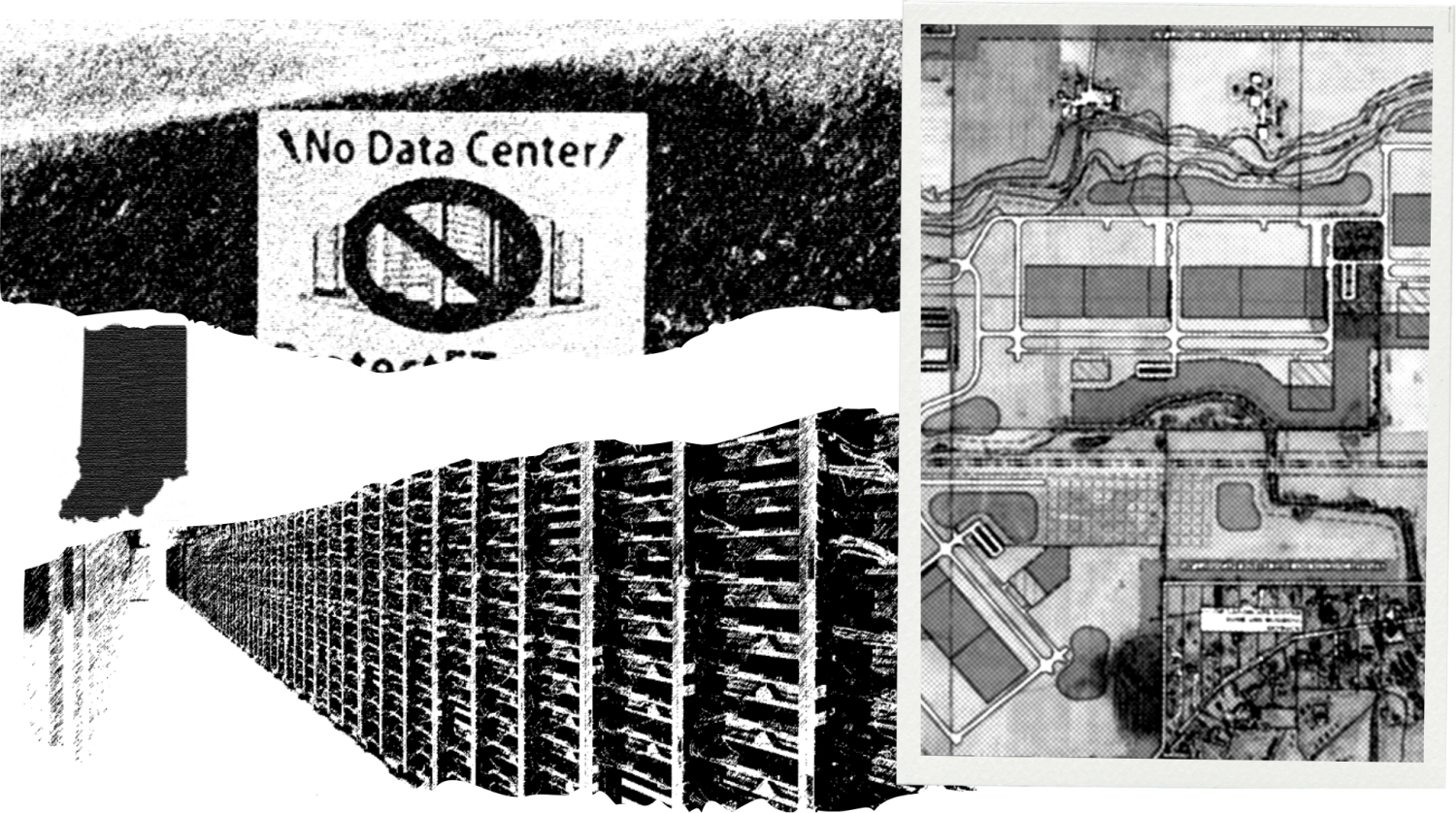
For months, residents in the Martindale-Brightwood neighborhood on Indianapolis’ northeast side have pushed back against a proposed 14-acre data center from Metrobloks.
The project faces a key rezoning hearing on Thursday. As the date nears, community members are calling on Mayor Joe Hogsett to intervene in the historically Black neighborhood’s latest development fight. T
hey argue the development could permanently reshape the neighborhood, which has long battled a history of pollution left behind by industrial development.”We don’t want any more closed-door deals,” said Shonna Majors, executive director of the Brightwood Community Center, who formerly worked for the city as a part of the Hogsett administration’s violence prevention initiative.
“We live here, we work here, we play here, we worship here,” Majors said during a press conference Tuesday at the Martindale Brightwood Community Development Corporation. But the Hogsett administration said they won’t be getting involved in rezoning issues.
Following the precedent set by previous administrations, this administration does not get involved in zoning decisions, spokesperson for Hogsett wrote in a statement. “Zoning is a highly technical process that involves multiple steps, reviews, and approvals from bodies like the Metropolitan Development Commission and in some cases the City-County Council.” Paula Brooks with the Hoosier Environmental Council disagreed.
She said the data center proposal is not just about land use. She points out that Hogsett also chairs Indy Economic Development, a city-affiliated nonprofit that helps shape large-scale development projects.
“This is not a zoning decision,” Brooks said. “This is a transformational industrial project, a heavy industrial project that will transform this neighborhood, and not for the better.”
Residents of the community say the proposal has reignited longstanding concerns about pollution in the area — including lead-contaminated soil — and fears that the project could bring additional burdens related to noise, water use and power demand.
So far, the rezoning requests submitted by Metrobloks to build the nearly 14-acre data center have not been heard in any public hearings with authority.
Federal EPA Repeals Endangerment Finding
By Carrie Albright

On February 12th, the EPA finalized one of the most consequential climate decisions in decades—repealing the endangerment finding. This is the legal foundation that has been used by the federal government to regulate greenhouse gas emissions.
EcoReport has shared about this pending decision over the last few months, hopeful that the outpouring of organizations and individuals arguing for this process to remain intact.
In 2009, the Supreme Court ruled that greenhouse gases are air pollutants under the Clean Air Act. The EPA, using extensive scientific analysis, then concluded that carbon dioxide and other greenhouse gases endanger public health and welfare. That finding became the legal foundation for regulating emissions from vehicles, power plants, and factories, a core component of environmentally responsible decisionmaking at the national level.
By repealing the endangerment finding, the EPA removed both the scientific and legal basis requiring federal regulation of greenhouse gases.
EPA Administrator Lee Zeldin called it “the single largest deregulatory action in U.S. history,” claiming it will save Americans more than $1.3 trillion by eliminating emission standards for vehicles from model years 2012 through 2027 and beyond.
Yes, you heard that correctly—the head of the Environmental Protection Agency has announced that prioritizing manufacturing and finance outweighs human health and safety. The removal of the endangerment finding reveals the fundamental shift taking place in the EPA under this administration.
It is unsurprising that climate experts and public health groups are sounding alarms. Dr. Katharine Hayhoe, chief scientist at The Nature Conservancy, emphasized that since 2009, the scientific evidence connecting greenhouse gas emissions to health impacts has only gotten stronger. Without the endangerment finding, regulating greenhouse gas emissions is no longer a legal requirement.
Multiple lawsuits have already been filed challenging the repeal, including from the Conservation Law Foundation, the American Lung Association, and other environmental advocacy groups. They argue the EPA cannot credibly claim that nearly two decades of scientific evidence is suddenly incorrect. This highly controversial decision is a major setback that will likely be fought in courts for years to come.
As Dr. Hayhoe articulates, “When foundational climate policies are repeatedly questioned, reversed or tied up in legal uncertainty, it becomes harder for families, businesses, and local governments to plan for the future. Stability matters. Predictability matters. Maintaining science‑based policies isn’t just prudent—it’s the reliable foundation we need to build a safer, healthier and more resilient nation.”
Winter Olympics Reduce Carbon Footprint
By Carrie Albright

If you’ve been enjoying the fun and games of the Winter Olympics in Italy right now, you’ve got another reason to cheer: Milano Cortina 2026 is being celebrated as a model for how major sporting events can reduce their environmental footprint.
Eighty-five percent of competition venues are existing or temporary structures—one of the highest reuse rates in Winter Olympics history. Instead of building new facilities that might sit empty afterward, a residual effect felt by many previous host cities, organizers retrofitted venues that had historically hosted winter events.
Almost all venues are powered by certified renewable electricity. The limited temporary generators run primarily on renewable biofuel.
The transport plan prioritizes trains and shuttles and targets 20 percent fewer cars compared to the 2006 Torino Olympics. Even the Olympic torch is powered by renewable bio-liquefied petroleum gas, and the medals are produced using recycled metal cast with renewable energy.
Snowmaking, which is incredibly energy and water intensive, is being kept to the minimum required for safe competition. High-efficiency systems use GPS monitoring to reduce unnecessary production, cutting electricity use by around 30 percent compared to traditional methods. No chemical additives are used, just water, air, and energy from renewable sources.
All of this is pretty impressive, but there is still room to improve how sustainably-oriented the Olympics can be. Eighty-eight Olympians and dozens of other elite athletes signed an open letter calling on the International Olympics Committee to ban fossil fuel companies from Olympic sponsorship.
As changing climate reshapes winter sports with shorter seasons, less reliable snow, and warming temperatures, the pressure is on to make these events sustainable. Milano Cortina is showing that venue reuse, renewable energy, and smarter resource management at this scale are possible.
Feature Report:

And now, lets listen to Gloria Chi as she reports on the Indiana Sustainability and Resilience Conference she attended.
Upcoming Events:

A new Winter Hike Series hike will take place on Saturday, February 21st, from, 11 am to 1 pm at Brown County State Park. The Boulder In The Tree hike is one of the most popular hikes. You get to see a boulder in a tree and then you can see if you can figure out how it got there. This is a very rugged, 2 mile hike.
The 17th Marsh Madness Sandhill Crane Festival will take place on Saturday, February 21st, beginning at 9 am at the Roy Clark Building in Humpfrey Park. This is a cultural, educational and wildlife conservation-oriented experience. See migrating cranes and waterfowl including the Spring migration of Sandhill Cranes.
Whooper Wednesday will take place every Wednesday until February 25th at Goose Pond Fish and Wildlife Area. Meet at the visitor’s center at 8 am to walk around the property to spot resident winter birds, including the endangered Whooping Crane. Dress for the weather.
You can a Maple Syrup Made Easy class at the RCA Community Park in the large shelter on Saturday, February 28th, from 1 to 2 pm. Learn how to make maple syrup during this hands-on workshop. Sign ups available at bloomington.IN.gov/parks.
You can take a Full Moon Hike at Brown County State Park on Saturday, February 28th from 7 to 8 pm. People are meeting at the Olympic Pool Parking lot to learn the history and lore of the March Full Worm Moon.
Credits:
This week’s headlines were written by Carrie Albright, Rich Benak and Caitlyn Looby
Today’s news feature was produced by Gloria Chi.
Julianna Dailey assembled the script which was edited by the EcoReport team and produced the upcoming events.
Kade Young is our engineer.
Anchors are Preston Rodgers and Julianna Dailey.