WFHB Bloomington Community Radio


Podcast: Play in new window | Download (Duration: 29:53 — 41.1MB)
Subscribe: RSS
Hello and welcome to Eco Report.
This week, we hear from Hud Mellencamp on why he and his father, John Mellencamp, have joined forces with a grassroots movement of concerned citizens, environmental advocates, odd bedfellows and local officials to halt potentially destructive and harmful methods of land management in the public forests of the Hoosier state. That’s coming up later in the program.
Your Environmental Reports:

Pike Township Residents Push Back Against Proposed Data Center in Urban Forest
Another week, another data center controversy in Indiana. Residents of Pike Township have joined the chorus of Hoosier communities actively speaking out against a proposed data center that would replace what’s currently a lush urban forest.
According to WRTV, American Tower—which already owns property where a 1,000-foot-tall broadcast tower is located—is proposing a rezoning that would allow construction of a 20,000 square foot data center on the site. Members of Protect Pike Township warn that removing this large swath of trees and forested area would lead to increased flood risk and destroy an important barrier against air pollution. The added use of backup diesel-fueled generators raises concerns about emissions and corresponding air quality impacts.
This is yet another instance of Indiana becoming a prime location for data centers, with developers taking advantage of affordable property and underdeveloped areas. The proposed rezoning will be considered by the City-County Council next week.
More Indiana Counties Enact Data Center Moratoriums Amid Growing Local Concerns
Some Indiana counties are getting ahead of these fights with data center moratoriums. A White County, a community just north of Lafayette, became the latest Indiana region to resist data center development, approving a moratorium after months of public opposition and uncertainty surrounding a proposed project.
The decision means White, Marshall, and Putnam counties have all put the brakes on data center development while they figure out what these projects could mean for local water supplies, land use, and infrastructure. In White County specifically, the moratorium came after a developer asked to rezone nearly 300 acres near Wolcott—a request that kept getting delayed as public opposition mounted.
These interactions are creating real tension between local control and state economic policy. Indiana passed tax breaks in 2019 to attract data center companies, and state officials keep promoting these facilities as crucial for competing in the AI economy. But many rural communities aren’t convinced—they’re worried about whether their water systems and power grids can handle it.
In recent years, 80% of Indiana counties have blocked wind or solar energy projects. Now data centers are becoming the next battleground in the same fight: who gets to decide what kind of development happens in local communities?
For now, these moratoriums give counties breathing room to study the impacts before making permanent decisions. But as more communities push back, the threat of state legislators eventually stepping in to take away local authority remains a reality.
Massachusetts Moves Forward on Climate Education with New Funding and Advisory Council
Massachusetts took a significant step forward for climate education last week when a key legislative committee advanced three bills that would bring climate science into classrooms across the state.
Two bills, Senate Bill 391 and the identical House Bill 560, would establish a trust fund to support climate education, prioritizing underserved communities and those disproportionately affected by climate change. The state’s education commissioner, working with a new Climate Literacy Advisory Council, could use the fund to develop lesson materials, support teacher training, and help districts share best practices. Senate Bill 410 would add “climate science and climate solutions” to the list of topics the state board of education is allowed to include in their standards.
Massachusetts joins a handful of other states making headway to a more informed and prepared next generation, but Massachusetts is taking a slightly different approach by creating a dedicated fund and advisory council rather than just mandating the topics. The idea is to give teachers real resources and support, not just add more requirements without tools and training.
If passed, Massachusetts would join a small but growing number of states recognizing the significance of taking an interdisciplinary approach and prioritizing communities that need support most. The bills are with the respective House and Senate Ways and Means Committees.
Australia Passes Sweeping Environmental Reforms to Protect Nature and Economy
In a time when environmental protections seem under constant threat, Australia just delivered some genuinely hopeful news—and it shows that ambitious environmental reform is still possible when leaders choose to lead.
Australia’s parliament recently passed sweeping reforms to their Environmental Protection and Biodiversity Conservation Act, overhauling environmental laws that had long been criticized as outdated and lackluster. According to Australian Environment Minister Tanya Plibersek, these reforms prove that protecting nature and growing the economy don’t have to be opposing forces.
Minister Plibersek explained that Australia’s old system was actually failing on both fronts—the environment wasn’t being protected, biodiversity was in systemic decline, and the messy, slow approval process was undermining economic productivity. Australia simply couldn’t afford environmental planning decisions that were duplicative and based on incomplete information.
The reforms create clear national standards defining what environmental impacts are “unacceptable” and must be avoided. They establish an independent national EPA to build integrity into decision-making and reduce political interference. And crucially, they write into law something profound: that environmental protection and biodiversity conservation necessarily underpin everything else—the economy, jobs, public health—and therefore must have primacy.
Plibersek called these reforms “an unprecedented bequest to future generations” which may be the most important takeaway for those of us watching from across the world. When the political will exists, it’s possible to design systems that protect nature while supporting economic transition and job creation. Australia just proved that environmental protection and economic prosperity can reinforce each other.
Feature Report:
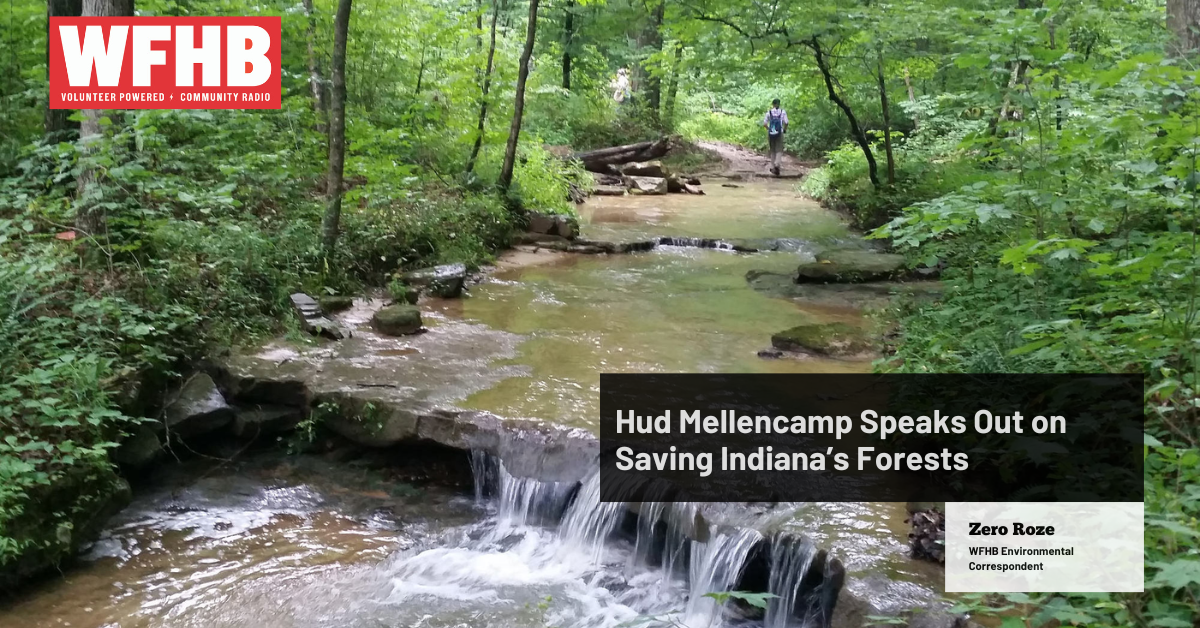
And now, we turn to Correspondent Zero Roze, who recently sat down with Hud Mellencamp, Bloomington local and son of the famous rocker, about becoming the voice of ‘Saving the Hoosier’, a new documentary film on everyday people striving to protect the health and well-being of their communities, future generations and the land they love.

And now for some upcoming events:

A Winter Weeds program is scheduled at McCormick’s Creek State Park on Saturday, December 6th, from 2 to 3 pm. Learn how to identify plant remnants in the winter and try some wild winter edible teas.
Whooper Wednesday will take place every Wednesday until February 25th at Goose Pond Fish and Wildlife Area. Meet at the visitor’s center at 8 am to walk around the property to spot resident winter birds, including the endangered Whooping Crane. Dress for the weather.
Take a Winter Splendor Hike at Spring Mill State Park on Saturday, December 13th, beginning at 10 am. Meet at the Spring Mill Inn front patio for a hike around Spring Mill Lake on Trail 5 while enjoying the beauty of the season.
There will be a Geminids Meteor Shower and Telescope Viewing at Fairfax State Recreation Area at Monroe Lake on Saturday, December 13th, from 6:30 to 7:30 pm. Drop by to watch the night sky and see “shooting stars!”
Credits:
This week’s headlines were written by Carrie Albright
Today’s news feature was produced by Zero Roze
Julianna Dailey assembled the script which was edited by the EcoReport team and produced the upcoming events.
Branden Blewett and Rich Benak were today’s engineers.