 WFHB Bloomington Community Radio
There’s been a whirlwind of information circulating with respect to public media, threats to de-fund it and what’s at stake for your local community radio station WFHB if those threats are followed through. I will try to unpack this ongoing story and show you some quick and easy ways you can take action to protect public media so that WFHB can continue its mission: to provide an open forum for the exchange and discussion of ideas and issues, and to celebrate and increase the local cultural diversity.
First off, you may have heard about federal funding cuts to public broadcasting or about an Executive Order instructing the Corporation for Public Broadcasting (CPB) to withhold funding for both National Public Radio (NPR) and Public Broadcasting Service (PBS). Perhaps you caught that right here in Indiana, Indiana Public Media watched its funding come to a screeching halt.
Maybe you’ve also heard of President Trump’s attempt to fire three board members at the CPB and their subsequent lawsuit against the administration, defending its position as a nonprofit entity and not part of the Federal Government, and therefore not under his control. What about the subsequent attempts by DOGE to embed itself into CPB operations?
And if you’re really in the weeds, you may have caught that Voice of America (VOA), which is controlled by the federal government and heard across the globe near U.S. military bases, will begin airing One America Network (a.k.a. OAN) content. This is after an attempt to dismantle VOA by the Trump administration failed. All while Diversity, Equity, and Inclusion efforts across the federal government are gutted, abandoned by corporations, and institutions of higher education face funding threats if they maintain their DEI initiatives.
You can come to your own conclusions about these events, but it’s obvious that public media and the work that WFHB is doing is under threat like never before. What is not as obvious is that public media goes beyond NPR and PBS. Smaller radio stations like WFHB, especially in rural or Tribal areas across the country, will feel the biggest impact from a lack of federal funding sources.
Also, what is not obvious is what, or who, the “CPB” is, what it does, and what’s at stake if Congress were to de-fund it. The Corporation for Public Broadcasting was formed when Congress passed the Public Broadcasting Act of 1967. One of its core tenets, “to encourage the development of programming that involves creative risks and that addresses the needs of unserved and underserved audiences, particularly children and minorities.” This idea was a North Star for the development of programs like Sesame Street, Mr. Rogers’ Neighborhood, countless documentaries, and other educational programming and is similar in mission to WFHB’s.
Beyond Sesame Street, the CPB supports small, local community TV and radio stations like WFHB through its Community Service Grant (CSG) program. The CSG also supports rural and tribal stations across the country to assure local and national information and entertainment is available all across the nation. Public media assures there are no “news deserts” as local for-profit media wrestles with its own challenges. Cuts to federal funding of public broadcasting will disproportionately impact these smaller stations in Tribal and rural areas.
It’s expensive to run a radio station, especially if you’re a non-profit that tries to bring quality programming to the dial. The CSG allows small, non-commercial stations to punch above their weight class with respect to the services and coverage they can provide. It helps fund infrastructure for the Emergency Alert System among other essential broadcasting equipment. For perspective, WFHB receives around $110,000 from the CPB annually, about a quarter of the station’s operating budget–even though the CPB only costs each taxpayer $1.60 per year. These small contributions add up to ensure that you and your neighbors have access to what’s happening in your community and on the world stage.
Additionally, the CPB also negotiates blanket music licensing rights for the 1,500+ stations that receive its funding. Music may be the elixir of life, but it’s also copyrighted, and radio stations have to pay license fees to broadcast it. Without the group buying power and blanket license that the CPB brings to the table, each station will be forced to negotiate a fee and license with each publisher or record label on their own, increasing costs and limiting what music can be aired on their stations.
Like the rural and Tribal station’s that CPB supports, community radio helps to bond the local culture of each unique community; to be an amplifier, speaking truth to power. It gives a voice to those impacted by policy. Public media supports people by making sure they have access to programming that enriches the many over the few.
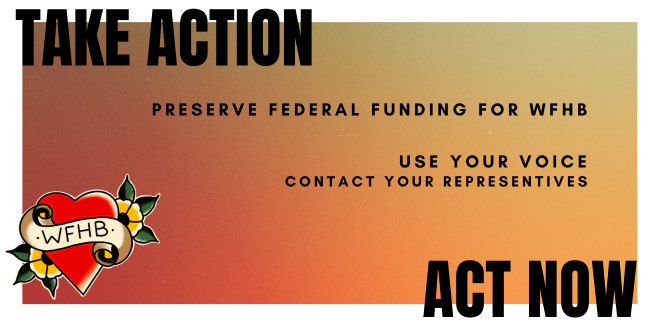
In times of crisis, local public media is a lifeline. The frequencies they occupy are precious and rare. Once they are gone, they are not coming back. There is, after all, only so much space on the dial. You have the power to help preserve public media’s future and we have strength in numbers. Visit protectmypublicmedia.com and join the fight. Tell your representatives to keep federal funding for the Corporation for Public Broadcasting intact.
Keep Public and Community Radio going. Forever and ever. Do it right now.
It’s up to us.
Jar Turner
General Manager
WFHB