WFHB Bloomington Community Radio

Podcast: Play in new window | Download (37.8MB)
Subscribe: RSS
Hello and welcome to Eco Report.
Later in the program, Environmental Correspondent Zyro Roze speaks with Michelle Higgs about how her time as a Community Organizer with Hoosier Action prepared her for her run for Indiana House District 60, which includes parts of Monroe County.
The New York Times reports that global warming creates conditions more favorable to severe storms. As the planet warms, severe storms of all kinds are likely to deliver even bigger payloads of rain. The reason: Warmer air holds more moisture, which effectively increases a storm’s capacity to carry precipitation.
Because the air can hold more moisture, that also means there is more water vapor in the sky that can condense into liquid, forming clouds. The heat energy released into the atmosphere by this condensation is what feeds thunderstorms. In short, more condensation, stronger storms.
Scientists are still trying to understand how this is playing out. Just because the ingredients are in place for a powerful storm doesn’t mean a powerful storm always materializes. Plenty of other factors shape when and whether storms form, and how destructive they become, which means it’s not straightforward to determine how global warming might be affecting overall storm trends.
Theoretically we understand very well what’s happening, said Andreas F. Prein, a climate scientist at the National Center for Atmospheric Research in Boulder, Colo. But how this then translates into severe convective storms, and what we saw recently, is a little bit more questionable. Thunderstorms can also produce strong winds that fan out in straight lines rather than
twisters. In a study published last year, Dr. Prein estimated that much larger areas of the central United States were now experiencing these straight-line gusts compared with the early 1980s. Thunderstorm damage is already causing big losses to home insurers.
The market for homeowners insurance has been in turmoil in the United States, and not just because of hurricanes and wildfires. As a New York Times investigation documented this week, severe storms are also causing insurers to lose money on homeowner coverage. These losses are affecting insurers in places like Iowa, Arkansas and Ohio, far from the coastal areas that are most battered by hurricanes.
The New York Times chronicles changes occurring in the insurance industry. The insurance turmoil caused by climate change — which has been concentrated in Florida, California and Louisiana — is fast becoming a contagion, spreading to states like Iowa, Arkansas, Ohio, Utah and Washington. Even in the Northeast, where homeowners insurance was still generally profitable last year, the trends are worsening.
In 2023, insurers lost money on homeowners coverage in 18 states, more than a third of the country, according to a New York Times analysis of newly available financial data. That’s up from 12 states five years ago, and eight states in 2013. The result is that insurance companies are raising premiums by as much as 50 percent or more, cutting back on coverage or leaving entire states altogether. Nationally, over the last decade, insurers paid out more in claims than they received in premiums, according to the ratings firm Moody’s, and those losses are increasing.
The growing tumult is affecting people whose homes have never been damaged and who have dutifully paid their premiums, year after year. Cancellation notices have left them scrambling to find coverage to protect what is often their single biggest investment. As a last resort, many are ending up in high-risk insurance pools created by states that are backed by the public and offer less coverage than standard policies. By and large, state regulators lack strategies to restore stability to the market. I believe we’re marching toward an uninsurable future in many places, said Dave Jones, the former insurance commissioner of California and now director of the Climate Risk Initiative at the University of California Berkeley law school.
Insurers are still turning a profit from other lines of business, like commercial and life insurance policies. But many are dropping homeowners coverage because of losses.
Climate troublemaker La Niña isn’t here yet – but it is on the way, federal weather forecasters said in a report released last week. In fact, forecasters from the National Oceanic and Atmospheric Administration gave the climate pattern as much as an 85% chance of forming by late fall. We are very confident that La Niña will form by this fall, Nat Johnson, a NOAA meteorologist, told USA TODAY.
Once it forms, it’s also supposed to last through next winter and would impact U.S. weather throughout the coldest months. Of more immediate concern, there’s also as much as a 69% chance it will develop by the summer months, NOAA said. This is key because a full-fledged La Niña could worsen the severity of the Atlantic hurricane season, the heart of which is typically in September.
La Niña is a natural climate pattern marked by cooler-than-average seawater in the central and eastern Pacific Ocean. When the water cools at least 0.9 degree Fahrenheit below average for three straight months, a La Niña is declared.
Surprisingly, that small amount is enough to affect weather and climate patterns in the U.S. and around the world. The cycle between La Niña and its “sibling” El Niño is hugely important for agriculture worldwides. El Niño generally brings wetter conditions to the Americas, while a La Niña has the opposite effect. The LaNina in 2012 brought drought to Indiana. Much of the corn crop was lost.
The Thwaites Glacier is back in the news. This is the glacier that could cut loose anytime from its mooring on Antarctica and raise ocean levels. Now it has been discovered that ocean water is pushing miles beneath Antarctica’s “Doomsday Glacier,” making it more vulnerable to melting than previously thought, according to new research which used radar data from space to perform an X-ray of the crucial glacier.
As the salty, relatively warm ocean water meets the ice, it’s causing “vigorous melting” underneath the glacier and could mean global sea level rise projections are being underestimated, according to the study published Monday in the Proceedings of the National Academy of Sciences and reported by CNN.
The Thwaites Glacier in West Antarctica — nicknamed the “Doomsday Glacier” because its collapse could cause catastrophic sea level rise — is the world’s widest glacier and roughly the size of Florida. It’s also Antarctica’s most vulnerable and unstable glacier, in large part because the land on which it sits slopes downward, allowing ocean waters to eat away at its ice.
Thwaites, which already contributes 4% to global sea level rise, holds enough ice to raise sea levels by more than 2 feet. But because it also acts as a natural dam to the surrounding ice in West Antarctica, scientists have estimated its complete collapse could ultimately lead to around 10 feet of sea level rise — a catastrophe for the world’s coastal communities.
How likely is Thwaites to release from Antarctica soon? Now that the area is entering winter, it seems likely that release won’t occur this year. Scientists say that no further warming of the globe is necessary for the release to occur. Whenever it happens, there will be immediate consequences beyond dealing with a 2 foot rise in ocean levels. Home insurance rates could skyrocket in low-lying areas, or insurance companies could pull out of Florida and other low-lying states. Indiana is not helping because the coal interests still determine outcomes.
Carbon dioxide is increasing in the atmosphere 10 times faster than it has in the last 50,000 years, according to a new study led by researchers from University of St. Andrews and Oregon State University.
The findings shed light on periods of abrupt climate change in the planet’s history while offering new understanding of the impacts of today’s climate crisis. “Studying the past teaches us how today is different. The rate of CO2 change today really is unprecedented,” said Kathleen Wendt, lead author of the study and an Oregon State University assistant professor in the College of Earth, Ocean and Atmospheric Sciences, in a press release from University of St. Andrews. Our research identified the fastest rates of past natural CO2 rise ever observed, and the rate occurring today, largely driven by human emissions, is 10 times higher.
Feature Report:
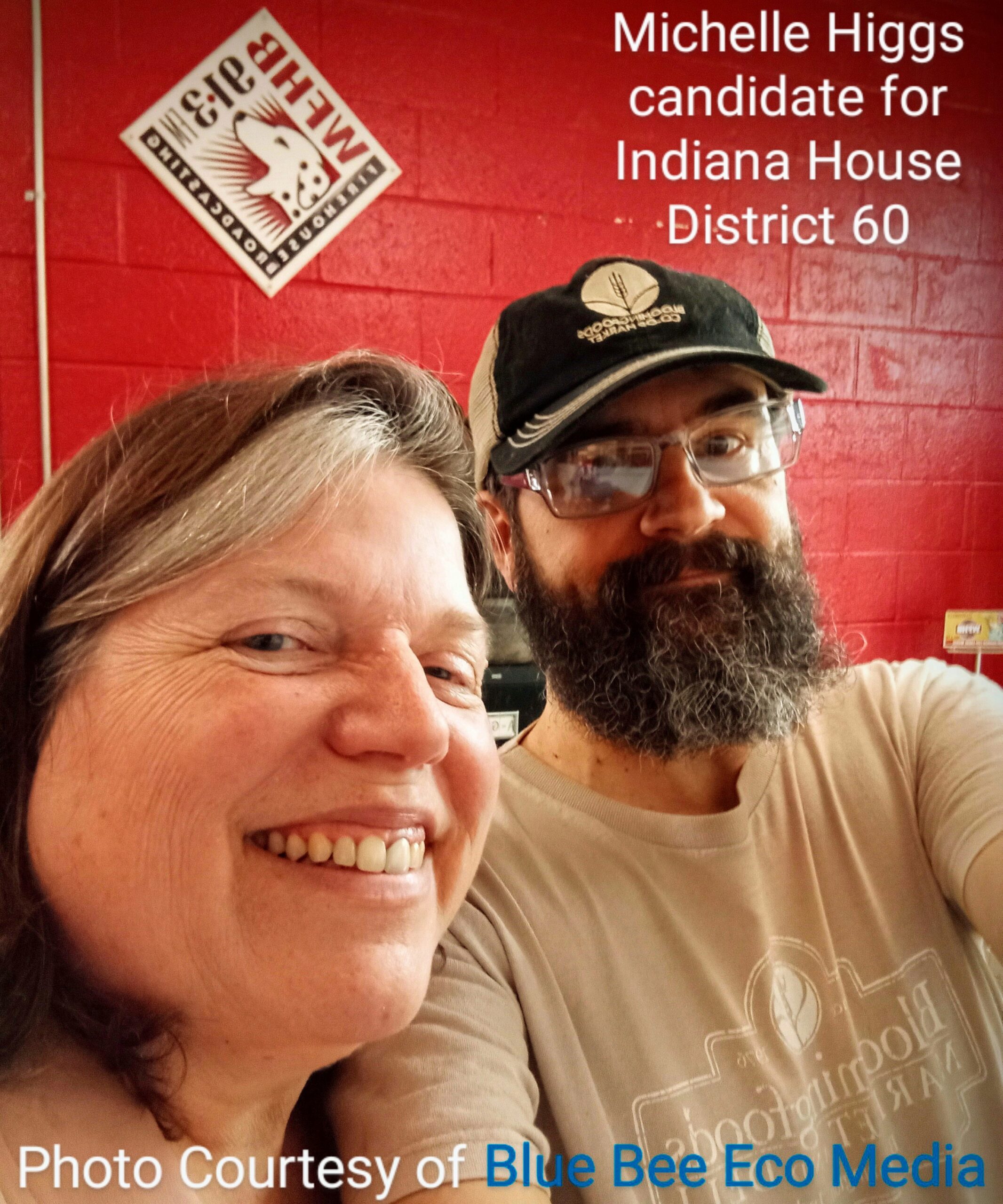
And now, we turn to Zyro Roze and his conversation with Michelle Higgs, a candidate for State government who got started in political activism by getting involved to address a toxic waste plume in Martinsville, the legacy of a dry cleaning operation in the town not far from Bloomington.
And now, some upcoming events:

- Learn about Twirling Ladybugs at Paynetown State Recreation Area at Monroe Lake on Saturday, May 25th, from 2 to 3:30 pm. Go to the Activity Center to make a twirling ladybug craft while learning how to tell the difference between our native ladybugs and the non-native lady beetle.
- Take a Woodpecker Walk at Spring Mill State Park on Sunday, May 26th, beginning at 11 am. Bring your binoculars for a short walk and talk about woodpeckers and then search for them. Meet at the Donaldson Cave parking lot.
- Learn the Secrets of Sinkholes at McCormick’s Creek State Park on Sunday, May 26th, from 2 to 3:30 pm. You will learn that sinkholes are the start of cave formations. Meet at the Deer Run Shelter to take a Karst Topography Hike on Trail 9, which is 1.2 miles into the woods.
- Beginner Kayaking is scheduled for Wednesday, May 29th, from 10 am to 12:30 pm at the Paynetown State Recreation Area at Monroe Lake. You will learn basic paddling and safety skills and enjoy supervised paddling time in quiet water. Sign up at tinyurl.com/kayak-May29-2024.
- A Free Fishing Weekend is planned for Saturday, June 1st and Sunday, June 2nd at Monroe Lake. This is a great opportunity to learn about fishing. Free fishing equipment is available at the Paynetown Activity Center.
Credits:
This week’s headlines were written by Norm Holy.
Today’s news feature was produced and edited by Zyro Roze.
Julianna Dailey assembled the script which was edited by the Eco Report team.
Julianna Dailey compiled our events calendar.
Kade Young is our engineer.